La Feria de Tarifa: What to Expect, When to Go, and How to Dress
Every September, Tarifa throws a party that lasts five days and nights. La Feria de Tarifa is the town's annual feria, a tradition rooted in Andalusian culture that turns the town into something between a village festival, a flamenco show, and a very long night out.
If your stay overlaps with it, consider yourself lucky. If you're planning a trip around it, this is what you need to know.
What is La Feria de Tarifa?
A feria is one of the defining institutions of Andalusian life. Every town has one, usually tied to its patron saint or tied loosely to the agricultural calendar. Tarifa's feria takes place each September, after the kite season is in full swing but before the summer crowds fully thin out.
The centrepiece is the recinto ferial, a dedicated fairground area on the edge of town, lit up with thousands of paper lanterns and lined with casetas. A caseta is a large marquee tent, each run by a social club, business, or political party, containing a bar, a kitchen, and a dance floor. Some are private (you need to know someone to get in); many are open to everyone who walks through the door.
Between the casetas: fairground rides, food stalls, horse parades, and several stages with live music.
When is it?
La Feria de Tarifa runs each year in September, typically Thursday through Monday: five full days. The opening ceremony, the alumbrado, takes place on Thursday evening when the fairground lights are switched on for the first time. This is a moment worth arriving early for.
Exact dates change slightly year to year. Check the Ayuntamiento de Tarifa website for the confirmed programme before you travel.
What actually happens during the feria
The feria runs on two distinct rhythms: daytime and night.
Afternoons (from around 5pm) are family time. Children pile onto the fairground rides. The horse parade, the paseo de caballos, winds through the streets, with riders in traditional dress and horses decorated with flowers. It's spectacular and unhurried. The casetas fill slowly, the atmosphere is relaxed, and the music is a mix of Sevillanas and pop.
From around midnight, the feria becomes something else entirely. The casetas are full. The Sevillanas are serious: couples and groups dancing together in a way that looks improvised but isn't, a dance form so embedded in Andalusian culture that most people learn it as children. It goes on until sunrise.
The programme usually includes:
- Paseo de caballos: the daily horse parade through the town
- Casetas open from afternoon through to the early hours
- Verbena: open-air dancing on the main stage
- Fairground rides (atracciones) for children and adults
- Live music across several stages, ranging from flamenco to pop
What to wear
There's no dress code for visitors. Ordinary summer clothes are perfectly fine. But the feria is one of the occasions when Tarifa's residents pull out their best traditional dress, and the effect is genuinely beautiful.
Women often wear trajes de gitana or trajes de flamenca, the full flamenco dress with ruffled layers, worn with flowers in the hair. Men wear either suits or the more traditional traje corto (a short bolero jacket, high-waisted trousers, and riding boots). Children are often dressed in miniature versions of both.
If you want to join in, Tarifa has several shops that hire out flamenco dresses for the week. You don't need to go all in. A flower in your hair and a bright dress is enough to feel part of it.
What to drink
The feria runs on rebujito: fino sherry mixed with Sprite or 7Up, served over ice in a large jug that a table shares. It's light, cold, and entirely suited to dancing in the heat. Almost every caseta serves it, and it costs very little.
Beyond rebujito, the usual range of beers, wines, and spirits is available. The food in most casetas is classic Andalusian: jamón, gambas al ajillo, tortilla, and whatever the kitchen is frying that evening.
Practical tips
Get there early on the first night. The alumbrado, the ceremonial lighting of the fairground, usually happens on Thursday evening and draws most of the town. It's worth arriving before it happens to find your bearings.
Explore more than one caseta. Each has its own atmosphere and music. Some are livelier, some more traditional. Walking the recinto and picking your spots is part of the experience.
Go in the afternoon with children, then come back later. If you have children, the afternoon session is genuinely enjoyable. Come back after midnight if you want to see the feria at full pitch.
Wear comfortable shoes. Sevillanas involves a lot of footwork and the ground in the recinto is uneven. Heels are traditional but flats are sensible.
Don't try to book a table. The casetas don't take reservations. You arrive, find space, and order from the bar. That's how it works.
The recinto is near the football stadium. The fairground sits beside the Campo de Fútbol, about a 15–20 minute walk from the old town. Taxis are easy to find heading in but harder to find at 4am heading out. Walking back is often the best option.
La Feria de Tarifa is one of the best reasons to visit the town in September, when the light is still long, the kites are still flying, and the town is at its most itself.
If you're staying at Terraza Atlántica during feria week, you're well placed: the old town is at your feet, and the recinto is within easy walking distance. Check availability for September and get in touch. We reply within 24 hours.
Come and see for yourself.
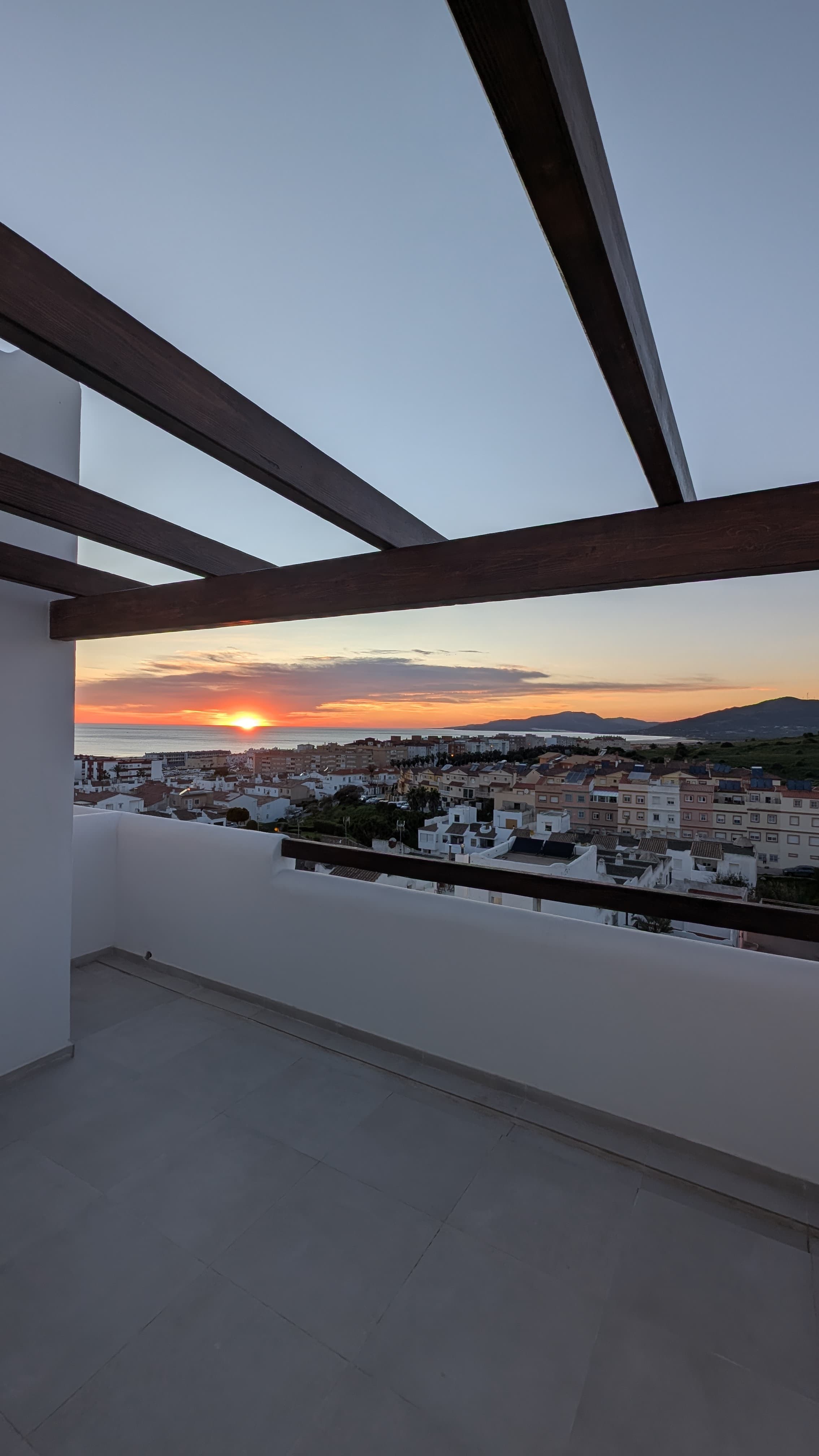
The terrace faces south. Africa on the horizon.