Tarifa Tuna Festival & Ruta del Atún: What It Is and When to Go
Every May and June, a quiet transformation comes over the fishing towns of Andalusia's Costa de la Luz. Restaurants hang chalkboards in their windows. Local fishmongers take deliveries before dawn. The smell of woodsmoke and charcoal fills the streets by lunchtime. The Atlantic bluefin tuna has arrived, and with it, one of the great culinary festivals of southern Spain.
The Ruta del Atún, the Route of the Tuna, is not a single event but a season: a rolling programme of gastronomic menus, cooking demonstrations, market stalls and local celebrations spread across half a dozen towns, running for several weeks each year. At its heart is one of the oldest and most extraordinary food traditions in Europe.
What Is the Almadraba?
To understand the festival, you first need to understand the almadraba.
Every spring, Atlantic bluefin tuna, some weighing over 300 kilograms, migrate from the cold waters of the Atlantic through the Strait of Gibraltar and into the Mediterranean to spawn. They have made this journey for millions of years. For the last three thousand of those years, humans have been waiting for them.
The almadraba is an ancient tuna trap: a labyrinth of nets anchored to the seabed in the shallow coastal waters near the Strait. As the tuna follow the coastline eastward, they enter the net system and are funnelled into a central chamber, the copo, where, once a sufficient number have gathered, they are harvested in a communal event called the levantá.
The technique was developed by the Phoenicians. It was refined by the Romans, adopted by the Moors, and passed down through the centuries to the four licensed operations that still practise it today along the Costa de la Luz: at Zahara de los Atunes, Barbate, Conil de la Frontera, and Tarifa. No other region in the world has maintained an unbroken tradition of almadraba fishing over such a span of time.
It is also one of the most sustainable forms of large-scale fishing in existence. The nets are set each spring and removed in summer. Only tuna that swim into the system are caught. There is no active pursuit, no bycatch. Quotas are set by the EU and strictly enforced. The bluefin tuna population in the Strait, once feared to be in terminal decline, has recovered significantly over the past two decades.
The Festival: What to Expect
The Ruta del Atún is, at its simplest, an opportunity to eat the finest bluefin tuna in the world, cooked by people who have been preparing it their entire lives, days after it came out of the sea.
The format is a tapas crawl. Each participating restaurant creates a small tuna tapa, a single, carefully prepared dish showcasing one cut or cooking method, served with a drink, typically for around €5–6. At the start of the festival you are given a map showing all the participating venues, with a space to collect a stamp from each one you visit. Complete your map and you are entered into a prize draw.
The result is one of the more enjoyable ways to eat your way around a town: moving between restaurants at your own pace, trying a different preparation at each stop, chatting to locals doing the same. The limiting factor, it should be said, tends to be the accompanying drinks rather than the food volume.
The variety is wider than most visitors expect. Bluefin tuna is not a single flavour; different parts of the fish have entirely different characters.
The cuts worth knowing:
- Ventresca: the fatty belly, marbled like wagyu beef, almost always served lightly seared or as sashimi. The most prized cut.
- Solomillo: the loin, leaner and firmer, excellent grilled over wood.
- Mormo: the neck, intensely flavoured, often slow-cooked.
- Tarantelo: between the belly and loin; somewhere between the richness of ventresca and the firmness of solomillo.
- Ijada: the flank, with a stronger flavour often used in cured or marinated preparations.
- Morrillo: the cheek, collagen-rich and extraordinary braised.
Beyond the restaurants, most towns run additional events during the festival period: cooking demonstrations, fishing exhibitions, historical talks on the almadraba tradition, and market stalls selling preserved tuna products (mojama, salt-cured tuna loin, tinned ventresca, tuna roe) that you can take home.
The Festival Towns
Zahara de los Atunes, whose name translates as "Flower of the Tunas" from the Arabic zahra (blossom) and the Spanish atunes (tuna), is perhaps the spiritual home of the almadraba festival. A small whitewashed village with one of the finest beaches on the Costa de la Luz, it draws large crowds during its festival week and tends to run one of the most spirited stamp-map crawls.
Conil de la Frontera tends to run one of the longest and most elaborately organised festival programmes. Its Feria del Atún typically spans two weekends, with a central event space, live music and a full market alongside the restaurant menus.
Barbate is the most working-port of the festival towns, less polished than Zahara or Conil, but arguably the most authentic. The local fishing fleet is active and visible; the tuna in the restaurants here has the shortest possible journey from sea to plate.
Tarifa hosts its own local events alongside the wider Ruta del Atún, and several restaurants in the old town run tuna menus throughout the season. As the town closest to the Strait itself, where the tuna are actually caught, there is something fitting about eating almadraba tuna here.
When Does It Take Place?
The Ruta del Atún runs from late May through June, tied to the almadraba season. The almadraba typically peaks in May and June, when the bluefin migration through the Strait is at its height; by July, the season is largely over and the nets come out of the water.
The exact programme, including individual restaurant menus and event dates, is announced each year, usually in April or May. Different towns run their headline events on different weekends, so it is possible to attend multiple festivals during a single trip.
Practical Tips
Don't worry about booking. Most participating restaurants during the Ruta del Atún don't take reservations. The culture is to turn up, wander, and see where takes your fancy. This is part of the charm. If there's a wait, you'll usually be handed a drink and told when your table is ready.
Go on a weekday if you can. Festival weekends in Zahara and Conil attract large crowds: atmospheric, but restaurants and car parks fill quickly. A Tuesday or Wednesday evening often offers a more relaxed experience of the same menus.
Take a cool bag. The market stalls at festival events are an excellent place to buy preserved tuna products at prices well below what you would pay in specialist shops elsewhere. Mojama and tinned ventresca pack and travel well.
Combine towns. All the festival towns are within 40 minutes of each other by car. A week's trip can comfortably take in events in Tarifa, Zahara and Conil: three entirely different atmospheres and restaurant scenes, all within easy reach.
Terraza Atlántica is in the centre of Tarifa, a few minutes' walk from the old town restaurants that participate in the Ruta del Atún each year, and an easy drive from Zahara de los Atunes and Conil. If you are thinking about timing a visit around the festival, get in touch and we can advise on what to book and when.
Come and see for yourself.
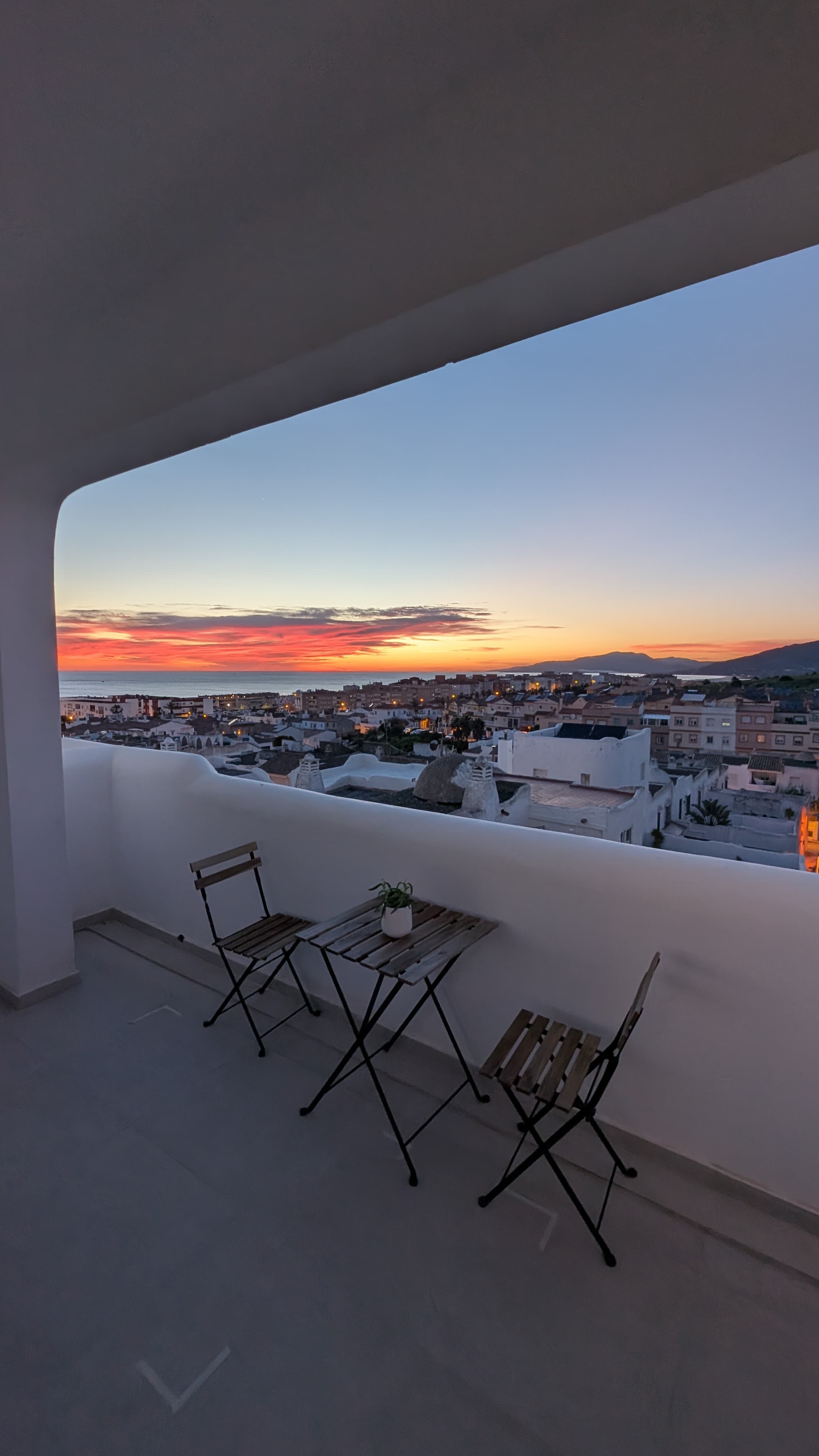
The terrace faces south. Africa on the horizon.