Things to Do in Tarifa, Spain: The Complete Activity Guide
Most people arrive in Tarifa because of the wind. Some come for the tuna, some for the old town, a few because they spotted Africa on a map and felt the pull. Whatever brings you here, the town has a way of keeping you longer than you planned. This is what to do while you stay.
Kitesurf or Windsurf the Strait
Tarifa is the wind capital of Europe: not a marketing slogan but a meteorological fact. Two prevailing winds alternate across the Strait of Gibraltar, the Levante from the east and the Poniente from the west. Between them, there are very few days when the water is completely still. Valdevaqueros, Los Lances and Punta Paloma are the main beaches, each suiting different wind directions and skill levels. Dozens of schools operate here, with international-standard instruction for complete beginners through to advanced riders. Even if you've never touched a kite, a lesson is one of the more memorable ways to spend a morning. See our full guide to kitesurfing in Tarifa for schools, costs and what level you need.
Walk the Old Town
Tarifa's casco antiguo is compact, whitewashed, and almost entirely car-free. The Moorish walls still stand, enclosing a tangle of narrow streets that open unexpectedly onto small plazas and sea-view terraces. The Castillo de Santa Catalina sits at the tip of the old town, built on the southernmost point of continental Europe. The medieval Castillo de Guzmán, named after Alonso Pérez de Guzmán who famously threw his own dagger to the Moors rather than surrender his son, is worth the small entry fee for the rooftop view alone. Allow two hours to wander without a plan.
Take a Whale Watching Boat
The Strait of Gibraltar is one of the richest whale and dolphin corridors in the world. Pilot whales, sperm whales, orcas, common dolphins and striped dolphins all move through these waters, drawn by the extraordinary convergence of two oceans and the tuna that migrate through each spring. Several operators run trips from Tarifa harbour, most lasting around two hours. The season runs from April through October, with summer offering the calmest seas and highest sightings rates. Book a morning trip for the best light.
Day Trip to Morocco
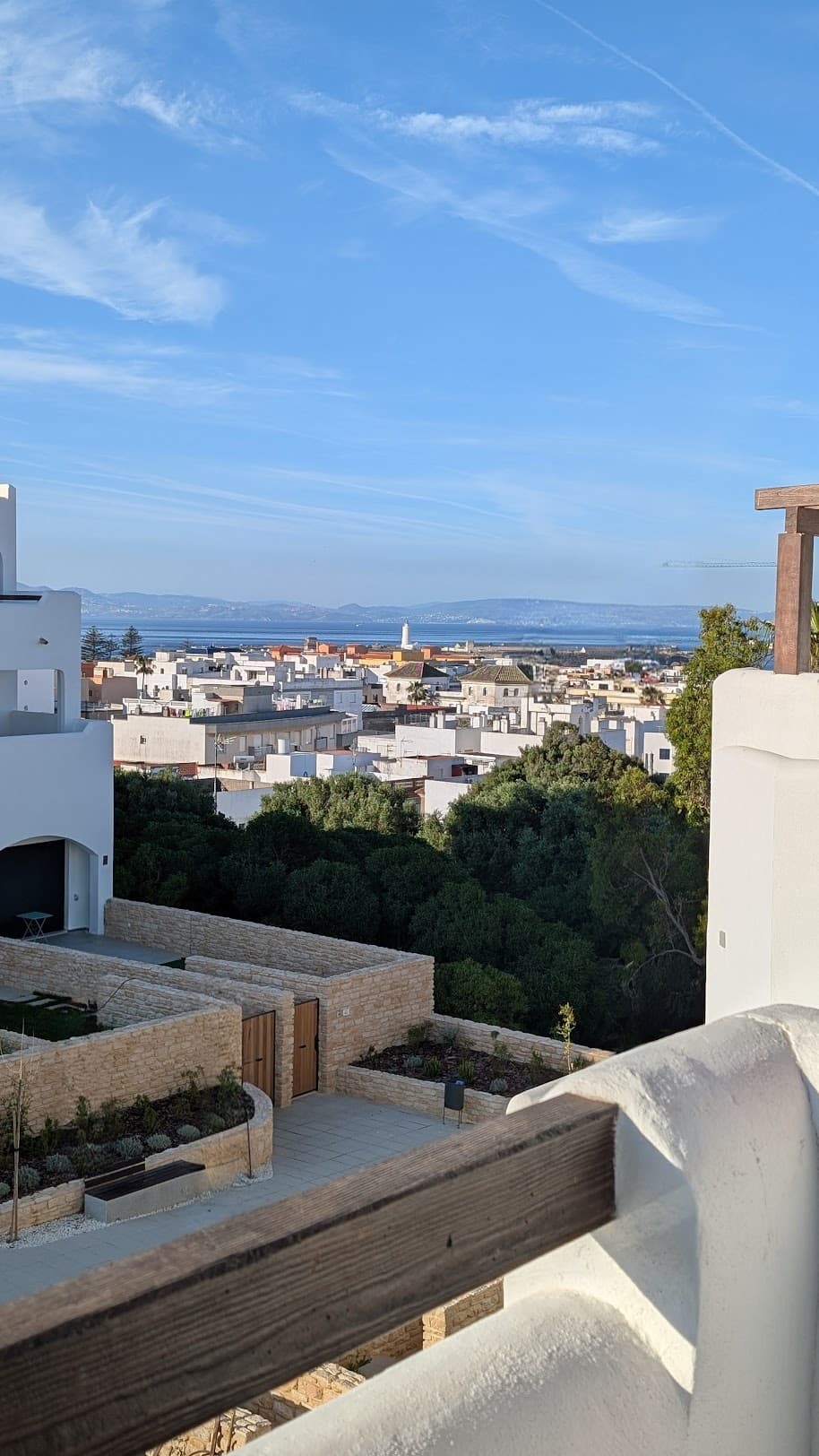
Africa is fourteen kilometres away. On a clear day you can see Moroccan windmills from the apartment terrace. The high-speed ferry from Tarifa to Tangier takes thirty-five minutes and runs multiple times daily. Tangier itself has transformed dramatically in recent years. The medina, the Kasbah, the food market and the Café Hafa (a clifftop tea house where the Rolling Stones once sat) are all worth the half-day it takes to explore them. Alternatively, arrange a guided day trip to Chefchaouen, Morocco's celebrated blue-painted hill town, about three hours south.
Eat the Tuna
Between April and June, the Almadraba, one of the oldest fishing techniques in the world, fills Tarifa's restaurants with wild-caught Atlantic bluefin tuna of extraordinary quality. The ventresca (belly), morrillo (neck) and atún encebollado (braised with onions) are the cuts to order. Outside of tuna season, the local seafood is outstanding: coquinas (tiny clams) with garlic and white wine, fresh boquerones, and tortillitas de camarones, paper-thin shrimp fritters that you'll find all along the Cádiz coast but which are particularly good here.
Watch the Bird Migration
Tarifa sits at the narrowest crossing point between Europe and Africa, which makes it one of the most important bird migration sites on the planet. Each spring and autumn, hundreds of thousands of raptors, storks and other birds of prey cross here on thermals: common buzzards, black kites, short-toed eagles, Egyptian vultures and honey buzzards among them. The Mirador del Estrecho, a short drive above the town, is a reliable spot to watch the spectacle. August and September are peak season for the southward autumn migration.
Hike or Cycle Los Alcornocales
The Los Alcornocales Natural Park, one of Europe's largest cork oak forests, begins just beyond the town limits. The trails range from gentle paths through the forest to more demanding routes up into the sierra, with views back to the sea and across to Africa. The park is particularly beautiful in spring, when wild flowers fill the clearings and the streams run full. Cycling is excellent on the quieter roads that wind through the park; bikes can be rented in town.
Yoga, Pilates and Wellness
Tarifa has quietly become one of southern Europe's most important destinations for mindfulness and holistic practice. The combination of the ocean, the wind, the light and a long-standing alternative culture has attracted an extraordinary concentration of teachers, studios and retreat centres for a town of this size. Yoga, Pilates, breathwork, meditation, sound healing, Kundalini, Yin: the options are genuine and varied, ranging from drop-in beach sessions at sunrise to week-long immersive retreats in the hills above the Strait. Several world-class teachers are based here year-round. If you are looking to deepen a practice, begin one, or simply spend a morning moving and breathing before the beach, Tarifa is an exceptional place to do it.
It is also worth knowing that Tarifa is the setting for the opening of Paulo Coelho's The Alchemist, one of the best-selling novels in history. The shepherd boy Santiago tends his flock in the fields outside the town before crossing the Strait to Morocco in search of his Personal Legend. The mystique and spiritual energy that Coelho evokes in those pages is not invented; it is something many visitors feel for themselves.
Tarifa is, uniquely, a place where two oceans meet, two continents face each other across a narrow strip of water, and two winds compete for the sky. People who come here often struggle to describe what they feel, but they feel something: an energy, a charge, a sense of being at a threshold between worlds. Whether that is geography, metaphysics, or simply the effect of standing at the edge of Europe with Africa fourteen kilometres away and the wind in your face, is yours to decide.
Work from a Café (or Stay for the Season)
Tarifa has become a magnet for digital nomads and remote workers, and it is not hard to see why. The town has a strong selection of cafés with reliable Wi-Fi and the kind of atmosphere that makes a morning of focused work genuinely enjoyable. The pace is unhurried, the coffee is good, and stepping outside at lunchtime means the beach, the old town or the Strait. Many people who come for a few days find themselves extending. A week becomes a month, a month becomes a season. A common concern before arriving is professional isolation. The reality tends to be the opposite. The cafés and co-working spaces of Tarifa are full of remote workers employed by some of the world's best-known companies: tech firms, creative agencies, finance, media. The network you find here is international, high-calibre, and unexpectedly easy to fall into. Long-stay apartment rentals are well established, and the combination of productive mornings, outdoor afternoons and a genuinely interesting social scene makes it one of the harder places in Europe to leave.
Swim at Bolonia
Twenty minutes north of Tarifa, Bolonia is one of the finest beaches on the Atlantic coast of Spain: a wide arc of pale sand backed by a Roman ruin (Baelo Claudia, a remarkably preserved first-century tuna-processing town) and a vast sand dune that rises from the beach like a small desert. It is largely undeveloped, rarely overcrowded even in summer, and the water is cleaner and calmer than the main Tarifa beaches. Go in the morning before the Poniente wind picks up.
If you are planning a trip from the UK, our complete Tarifa holiday guide covers flights, when to go, where to stay, and practical information in one place.
Terraza Atlántica is ten minutes' walk from the old town and the kitesurfing beaches, and a short drive from everything else on this list. The rear terrace faces south across the Strait. On a clear evening, you can watch the lights of Morocco come on as the sun sets behind you. Check availability if you'd like to use it as your base.
Frequently Asked Questions
What is Tarifa best known for?
Tarifa is best known as the kitesurfing capital of Europe, thanks to the strong and reliable winds that blow through the Strait of Gibraltar. It is also known for whale and dolphin watching, its well-preserved Moorish old town, proximity to Morocco (35 minutes by ferry), and the quality of its Atlantic bluefin tuna during the Almadraba season in spring.
Is there much to do in Tarifa if you don't kitesurf?
Yes. Tarifa has whale watching, day trips to Morocco, Roman ruins at Bolonia beach, excellent restaurants, a medieval old town with two castles, bird migration watching, hiking in Los Alcornocales Natural Park, and a lively yoga and wellness scene. Non-kitesurfers frequently find it has more to offer than they expected.
What is there to do in Tarifa in bad weather?
The old town is worth exploring on any day: the Castillo de Guzmán, the Moorish walls, the narrow streets and small cafés all work well in cooler or overcast weather. The Baelo Claudia Roman ruins at Bolonia are partly undercover and make a good cooler-day visit. Tarifa also has a good number of yoga and wellness studios for days when outdoor activity is not appealing.
How many days do you need in Tarifa?
Three to four days is enough to cover the main activities: a whale watching trip, a day trip to Morocco, time on the beach, and an evening or two in the old town restaurants. A week allows you to settle in, try a kitesurfing lesson, visit Bolonia, and explore the national park. Many visitors end up staying longer than planned.
Is Tarifa good for families?
Yes, with some planning. The beaches, whale watching and the Roman ruins at Bolonia are all family-friendly. The main thing to be aware of is the wind: on strong Levante days the beach can be uncomfortable for young children. Bolonia, which is slightly more sheltered, is the better beach choice on windy days.
Come and see for yourself.
The terrace faces south. Africa on the horizon.