Whale Watching in Tarifa: Best Time, Species and How to Book
The Strait of Gibraltar is one of the most extraordinary stretches of water on earth. Fourteen kilometres wide at its narrowest point, it is the only passage between the Atlantic Ocean and the Mediterranean Sea: a highway for fish, whales, migrating birds, and, for over three thousand years, human ships. Every species that moves between these two bodies of water must pass through here. Which is why, from the terrace of a Tarifa apartment, you can watch cargo ships, dolphins, and the occasional whale navigate the same narrow channel.
Why Are There So Many Whales Here?
The Strait is rich because it is productive. The meeting of two oceans at a narrow choke point creates powerful upwellings of cold, nutrient-dense water that support enormous populations of fish. The Atlantic bluefin tuna, famously caught each spring in the Almadraba traps, migrate through here in their tens of thousands. Sperm whales come to feed on the deep-water squid that flourish in the submarine canyon just west of the Strait. Pilot whales and dolphins follow the tuna. Orcas arrive in summer and autumn to intercept the bluefin.
This convergence of food makes the Strait one of the most reliable whale-watching sites in Europe: not a place where you might see something, but where, in season, you almost certainly will.
What Species Can You See?
Common dolphins (Delphinus delphis) are the most frequently sighted species: fast, acrobatic, and often drawn to the bow wave of a boat in large pods. Striped dolphins are slightly less common but equally spectacular.
Long-finned pilot whales are a regular presence, often seen in family groups of ten to thirty animals resting at the surface between dives. Their calm, social behaviour makes them particularly rewarding to watch.
Sperm whales pass through the Strait on their way to and from the deep canyon to the west. Sightings are less predictable but unforgettable when they happen. A bull sperm whale can reach eighteen metres in length.
Orcas (killer whales) are perhaps the most dramatic encounter available in European waters. A resident population of around forty individuals passes through the Strait each summer and autumn, following the bluefin tuna migration. They are the only orcas in Europe known to interact with fishing boats; the behaviour is unusual and the subject of ongoing research.
Fin whales, the second-largest animals on earth, pass through in smaller numbers, particularly in spring and autumn.
When Is the Best Time to Go?
The whale-watching season in Tarifa runs from April through October, with the peak months being June, July and August. Conditions are calmest in summer, which improves both the experience on the water and the likelihood of sightings. Orca sightings are concentrated in late summer and early autumn (August to October), when the bluefin tuna season peaks.
Spring (April to May) offers excellent conditions with smaller crowds and the possibility of seeing migrating whales moving through the Strait on their way to the Mediterranean.
The Trip
Most whale-watching boats depart from Tarifa harbour, a five-minute walk from the old town. Trips typically last two to three hours and venture four to ten kilometres out into the Strait. The boats are equipped with hydrophones, underwater microphones, that allow the crew to listen for whale calls below the surface and track movements in real time.
Book with an operator affiliated with CIRCE (the Spanish cetacean research organisation), which runs some of the most scientifically rigorous trips and contributes your fare to ongoing research. Trips fill quickly in high season; book at least a day in advance and preferably earlier.
What to bring: a light jacket even in summer (it can be significantly cooler on the water than on land), sunscreen, and something for seasickness if you are prone to it. The Strait can be choppy when the Levante blows, though experienced skippers know the calmer windows.
A Note on Responsible Watching
The cetaceans of the Strait are wild animals living in a working waterway shared with some of the world's busiest shipping lanes. Responsible operators maintain a respectful distance, turn off engines when near animals, and do not pursue them. Avoid any operator that advertises guaranteed sightings or allows passengers to enter the water with wildlife.
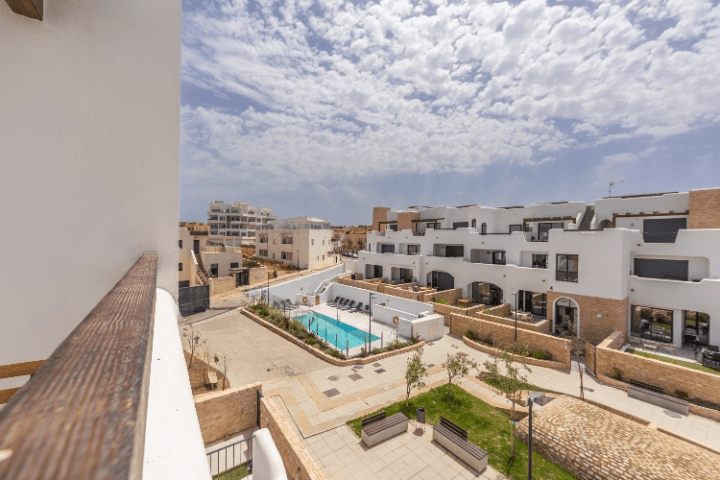
From the rear terrace of Terraza Atlántica, the Strait is laid out below you, and on a quiet evening, with binoculars, it is not unusual to spot a dorsal fin moving across the water between the lighthouse and Africa. Check availability if you'd like to see it for yourself.
Come and see for yourself.
The terrace faces south. Africa on the horizon.